 Kept
How to spot a catfish before you get attached
You can usually spot a catfish by a mix of signs: photos that look too polished, a story that doesn't add up and, above all, a steady refusal to video call or meet. A reverse image search and a short video chat will catch most fake profiles in minutes, so you can stop wondering and get on with dating real people.
What catfishing is
Catfishing means pretending to be someone else online, usually with another person's photos. Some catfish want attention or validation, some are hiding who they really are, and some are running a scam that ends with a request for money. You don't need to know their reason. You only need to know whether the person you are talking to is real.
Warning signs to watch for
One sign on its own isn't proof. A cluster of them is a strong reason to slow down and check.
- Every photo looks like a professional shoot or a model's portfolio, with no casual or group shots.
- They have very few photos, or all of them seem to be from years ago.
- Their profile is vague: no clear job, no friends mentioned, no real detail about daily life.
- They always have a reason not to video call: a broken camera, bad signal, a strict job.
- They want to move to another messaging app almost immediately.
- Their story changes, such as a different age, city or job from one week to the next.
- They are intensely affectionate very quickly, talking about love or the future within days.
- Plans to meet keep falling through at the last minute.
- Sooner or later, a problem appears that only money can solve.
Do a reverse image search
This takes about two minutes and is the single most useful check. Save or screenshot one of their photos, then search for it with a reverse image tool such as Google Lens or TinEye. You upload the picture and it shows where else that image appears online.
If the same photos turn up under a different name, on a model's or influencer's page, or on a stock photo site, you have your answer. If nothing turns up, that is reassuring but not proof, because some people use photos from private accounts. That is why the next check matters most.
Ask for a video call
A short video call is the clearest test there is. Keep it light and normal, for example: 'I'm enjoying chatting. Fancy a quick video call this week before we meet? Ten minutes is fine.'
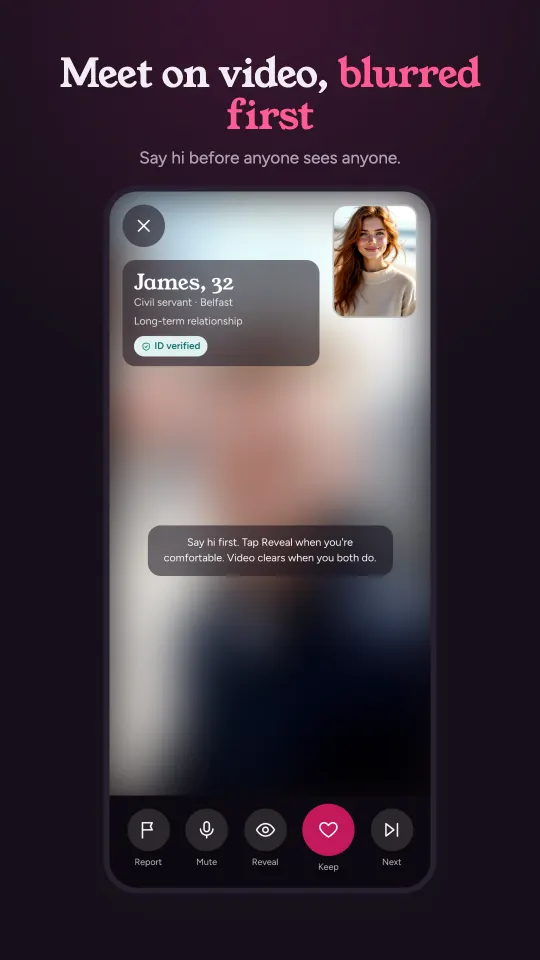
Someone genuine might be nervous, but they will usually agree or suggest another time. If they refuse again and again, the kindest thing you can do for yourself is to step back. Our video dating tips can help if the idea of a call feels awkward. Kept starts video meets blurred, and the picture only clears when you both tap Reveal, which takes the pressure off for shy but genuine people.
Other quick checks
- Ask a specific, friendly question about something in their photos, like where a picture was taken. Real people answer easily.
- Notice whether their messages respond to what you actually said, or feel copied and pasted.
- Look for verification badges, and remember they only mean as much as the check behind them.
- Ask a friend to look at the profile. People outside the conversation often spot what you can't.
- Suggest meeting for a short coffee in a busy place. A catfish will usually find a reason to delay, again and again.
Why it's easy to miss the signs
Catfish are good at making you want to believe them. They mirror your interests, remember small details and offer the kind of attention that feels rare. When you're enjoying a connection, it's natural to explain away a cancelled call or an odd photo, because questioning it feels like risking something good.
A simple way to stay grounded is to decide your checks in advance. For example: 'I'll do a reverse image search before I give my number, and I won't make plans until we've had a video call.' Then follow your own rule, however lovely the conversation is. Genuine people won't mind waiting, and anyone who pushes back hard is telling you what you need to know.
What to do if you think it's a catfish
You don't need to confront them or prove anything. Stop replying, then block and report the profile so the app can review it and protect other people. Keep screenshots if they have asked for money or personal details.
Never send money, gift cards or cryptocurrency, however upsetting their story sounds. If you have already sent money or bank details, contact your bank straight away and report it to Action Fraud on 0300 123 2040. Our guide to romance scam warning signs explains what to do next, and our wider dating app safety tips help you avoid it next time.
If you feel embarrassed, please don't. Catfish are skilled at what they do, and being fooled says more about their effort than your judgement.
Questions people ask
How do I reverse image search a dating profile photo?
Screenshot or save the photo, then upload it to a reverse image tool such as Google Lens or TinEye. It will show other places the image appears online, which can reveal stolen pictures.
Why won't my match video call?
Some people are just shy, but a repeated refusal over weeks is one of the most common signs of a catfish. Suggest a short call, and step back if they keep avoiding it.
Is catfishing illegal in the UK?
Pretending to be someone else isn't always a crime on its own, but catfishing often leads to fraud or harassment, which are. Report anyone who asks for money to Action Fraud on 0300 123 2040.